40 YEARS INTO THE JOURNEY
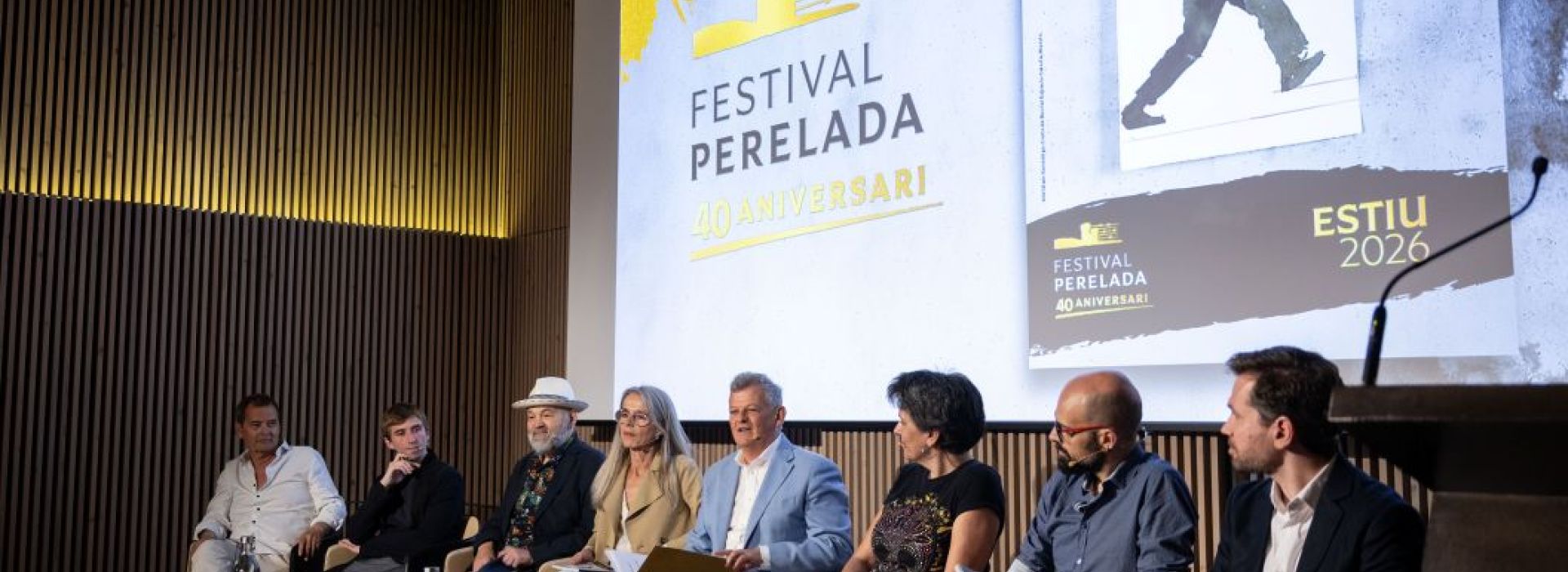
This morning, the Sant Pau Modernist Complex in Barcelona hosted the presentation of the artistic programme for the 40th edition of the Perelada Festival, which will be held from 17 July to 9 August across various venues within the Peralada Castle complex — including the Carmen Church, Mirador del Castell and Celler Perelada — as well as at the Palau de la Música Catalana concert hall.
Oriol Aguilà, the Festival’s artistic director, accompanied by choreographer Aleix Martínez, librettist Cristina Pavarotti, composers Alberto García Demestres and Carles Prat, writer Carlota Gurt, musician Marc Heredia (Trio Fortuny) and organist Albert Blancafort, unveiled the details of a particularly significant edition, marking the Festival’s 40th anniversary.
A programme that reaffirms its innovative, cross‑disciplinary nature and its commitment to artistic excellence, positioning Perelada once again as a meeting point for multiple artistic languages, from opera and dance to chamber music and contemporary creation. The programme brings together major international names with the vitality of today’s creative output, in constant dialogue with the spaces that host it.
Julia Reger Suqué, speaking on behalf of the Suqué‑Mateu family, welcomed the audience by emphasising that “forty years not only represent a history, but also explain a journey. A journey forged by a commitment to culture, artistic rigour and a determination to leave a lasting mark.” He also highlighted that the Festival is “a space that goes beyond the programme, where ideas are generated, creation is supported and links are forged between artists, the public and the region.”
The president of the Perelada Festival, Isabel Suqué Mateu, also shared a few words to mark this edition: “This anniversary represents the continuity of a project that understands culture as a space of freedom and inspiration. Today, Perelada is a meeting place for creators and audiences and a project that continues to grow true to its spirit. It is also a moment to remember my parents, Carmen Mateu and Arturo Suqué, founders of the Festival, who forty years ago launched this project with a clear cultural vocation and a firm commitment to society through patronage."
The Perelada Festival reaffirms itself as an essential event for lovers of music and the performing arts, with a programme that brings together creativity, heritage and contemporary expression in a unique setting.
Oriol Aguilà, the Festival’s artistic director, emphasised that “this 40th‑anniversary edition aims to highlight the Festival’s journey not through a retrospective lens, but as a path that remains open, where dance and opera – two of the pillars that define our identity – play a central role in a unique programme on the Costa Brava.” “We are celebrating this anniversary by sharing it with artists who are also at significant moments in their careers, inviting them to be part of this shared journey and to embrace the spirit of the Festival,” he added.
“40 Years into the Journey is also the expression of a project that has been consolidated over time through initiatives such as the Peralada Campus, the Carmen Mateu Award, and the ongoing commitment to creation and the internationalisation of the Festival. More than a slogan, it is a way of understanding Perelada: as a living, dynamic space built on the experiences that take place there and on its relationship with its audience,” said Aguilà.
Recitals and chamber music at the Carmen Church
The Gothic Carmen Church once again takes centre stage at the Festival, hosting some of the elements most representative of its musical identity: the human voice, intimacy and shared listening.
On 17 July, the exceptional duo of soprano Ermonela Jaho and tenor Benjamin Bernheim will open the Festival with a recital that explores Italian and French opera. The programme is structured around a journey where the voice becomes a meeting point between text and music. Works by Cilea, Puccini and Verdi enter into dialogue with the lyrical elegance of Gounod and Massenet, forming an arc that moves from the most restrained delicacy to the most overt drama. Jaho’s interpretative intensity meets Bernheim’s elegance and stylistic refinement in a performance of great expressive coherence.
On 25 July, bass‑baritone Bryn Terfel returns to the Festival with a recital presented as a synthesis of his artistic career. Accompanied by Hannah Stone on the harp and Annabel Thwaite on the piano, the programme, conceived as a narrative, explores Welsh music, Central European Lied and the operatic repertoire, tracing a journey that spans languages, traditions and soundscapes. From folk songs to Schubert, Schumann and Debussy, with occasional forays into opera such as Wolfram’s aria from Tannhäuser, the recital transforms the voice into a space of memory and identity, where each piece forms part of a single expressive continuum.
On 26 July, the Carmen Church will host the world premiere of Diario di una madre, a song cycle by Alberto García Demestres with lyrics by Cristina Pavarotti, performed by soprano Sabina Puértolas and pianist Rubén Fernández Aguirre. Conceived as an imaginary diary, the work unfolds across fourteen songs and two piano interludes that span an entire lifetime: from the moment a mother senses the presence of her daughter to the moment when memory begins to fade. Along this journey, the words—direct, lucid and laced with irony—enter into dialogue with a musical composition that alternates between lyricism and tension, creating an expressive space where emotions are not fixed but transformed.
On 5 August, Trio Fortuny will celebrate its tenth anniversary with a programme conceived as a journey through the piano‑trio repertoire, from the structural intensity of Beethoven to the expressive intensity of Shostakovich, via the lyrical depth of Schubert and the delicate writing of Mel Bonis. It highlights the ensemble’s capacity for dialogue and its timbral richness, qualities that over the years have shaped a distinctive musical language. The concert also features the premiere of Ronde, by Francisco Prat, reinforcing the trio’s connection with contemporary creation. The participation of Judit Neddermann, who joins the ensemble for two pieces, introduces a new vocal dimension that expands the boundaries of the format and opens the programme to other sensibilities.
On 6 August, the Festival will pay tribute to Montserrat Torrent on the centenary of her birth, honouring one of the most influential figures in the recovery and promotion of organ heritage in Catalonia. The concert, which incorporates the organ into the Festival’s programme for the first time, will take place at the Carmen Church in Peralada Castle and will bring together Montserrat Torrent with organists Paolo Oreni and Joan Seguí around the Wanderer modular organ, an instrument capable of conveying the rich timbral palette of this repertoire. The evening will include two world premieres commissioned by the Festival, by Bernat Vivancos and Raquel García‑Tomás, in a programme conceived as a space for intergenerational exchange, where legacy is remains a living presence in the present.
On 8 August, soprano Sara Blanch and tenor Michael Spyres will share the stage in a recital centred on bel canto, a genre that demands technical precision, flexibility and great expressive power. It is an exceptional encounter between two remarkable careers: Blanch, whose luminous and agile voice has established her on major international stages, and Spyres, a unique figure in today’s operatic landscape, capable of moving with natural ease between registers and styles. A recital that places singing on the boundary between control and risk, where form is shaped anew in every phrase.
Finally, on 9 August, Jordi Savall and Núria Rial, together with Les Musiciennes du Concert des Nations, will bring the Festival to a close with a programme dedicated to the Italian Baroque. This performance reflects an approach to the repertoire that understands it not as a fixed legacy but as a living entity, shaped by gesture, phrasing and the shared listening between voice and instruments. The artistic rapport between Savall and Rial, forged over many years, results in an interpretation that combines rigour, sensitivity and historical awareness, offering a contemporary perspective on this music.
Contemporary theatre and dramaturgy
The Mirador del Castell has established itself as the venue dedicated to contemporary theatre and dance, presenting productions that bring music, the body and dramaturgy into dialogue from a contemporary perspective open to new languages.
On 18 July, the Festival will celebrate its fortieth anniversary with 40 Years into the Journey, a theatrical and gastronomic event conceived by Joan Anton Rechi. Designed as a journey through the Festival’s past and present, the evening combines music, dance and spoken word in a format that blurs the boundaries between disciplines and incorporates gastronomy as part of the experience. As Rechi himself notes, “it is not about looking back with nostalgia, but about understanding the past as a living force that continues to project itself into the future”. Featuring guest artists whose identities will be revealed throughout the evening, the event will include the participation of choreographer Botis Seva, winner of the Carmen Mateu Young Artist European Award, who will present an excerpt from Sing Child Sing, a Festival commission. The programme is conceived as both a celebration of the journey so far and a look towards the future.
On 25 July, the Festival will present Aesthetics and Massacre by Carles Prat, a contemporary opera created as part of the Gran Teatre del Liceu Òh!pera project. Conceived as a tragicomedy for two characters (soprano and baritone), the work explores the construction of identity in the digital age, in a space of tension between who we are and how we present ourselves. With a libretto by Carlota Gurt, one of today's most distinctive literary voices, and stage direction by Oriol Pla, a theatre creator and performer with a recognised career in the audiovisual sector, the production is designed as a framework where music, text and image engage in active dialogue.
On 28 July, Niu, by Aleix Martínez, will celebrate the tenth anniversary of the Peralada Campus with a production that forms part of this training project promoted by the Festival. Rooted in the local area, the project brings together young dancers and musicians in training with internationally renowned artists, in a working process that combines learning, experimentation and stage creation, and which this year is supported by a collaboration with Condis Supermercats. The presence of dancers from the Hamburg Ballet and the participation of musician Arnau Obiols reinforce this dialogue between contexts and languages. Conceived as a space for support and a place of departure, the piece offers these performers a space where they can begin to develop their own voice alongside other perspectives and experiences.
On 29 and 30 July, Sílvia Pérez Cruz will return to the Festival with a new project presented as a journey through two textures, two ways of inhabiting song: from an intimate, secluded space towards a more open and expansive dimension. The piece moves naturally between languages and genres, placing the voice at the centre of an experience that combines expressiveness with a powerful emotional charge.
On 1 and 2 August, 4 Danced Seasons offers a new interpretation of Antonio Vivaldi’s The Four Seasons, in a dialogue between Baroque music and urban dance. With musical direction by Julien Chauvin at the helm of Le Concert de la Loge and choreography by Mourad Merzouki, one of the key figures in the integration of hip‑hop into the contemporary scene, the production brings musicians and dancers together on the same stage, blurring the boundaries between concert and choreography. Far from being a formal reinterpretation, the show emphasises the rhythmic and physical dimensions of the score, creating a stage experience of great energy and precision.
A journey between body and matter
On 31 July, Celler Perelada will host Le Terroir, by choreographer and dancer Lorena Nogal, a site‑specific piece created for this venue and premiered at the last edition of the Festival. Inspired by the wine-making process - from ingredients to fermentation, from time to transformation - the piece draws a parallel with the body, understood as a territory in constant flux. The work unfolds as a journey in which the audience accompanies the action, within a stage setting that integrates space, movement and perception into a deeply sensory experience.
Perelada and Bayreuth at the Palau de la Música Catalana
As part of its 40th‑anniversary celebrations, the Perelada Festival presents a special concert at the Palau de la Música Catalana featuring the Bayreuth Festival Orchestra, conducted by Pablo Heras‑Casado. An event that extends beyond the Festival’s usual setting, it is set to be one of the highlights of this year’s edition, both for the uniqueness of the ensemble and its connection to the Wagnerian tradition, marking one of the high points of the programme.
The programme, centred on excerpts from Der Ring des Nibelungen, creates a sonic universe of great expressive and dramatic intensity. The presence of leading Wagnerian voices such as Catherine Foster, Klaus Florian Vogt and Nicholas Brownlee further strengthens this exceptional concert. The orchestra, an international benchmark in Wagnerian performance, offers the opportunity to experience a musical approach built on continuity and the pursuit of a distinctive sound.
This programme reinforces the Festival’s international standing and its capacity to forge partnerships with leading institutions at a particularly significant moment in its history.
An exhibition on transformative moments
Alongside the artistic programme, the Perelada Festival presents the exhibition Perelada Festival: Transformative Moments. 40 Years of History, a project that highlights four decades of history from a perspective that moves away from a chronological approach to focus instead on the key moments that have defined its journey. Shown at the Peralada Castle Museum from June to December 2026, the exhibition is structured around twelve moments — artistic decisions, bold moves and paradigm shifts — that have shaped our understanding of contemporary creation, positioning the Festival as a catalyst for cultural processes beyond its immediate scope.
These moments encompass a wide range of objectives. They include the commitment to emerging directors and creators, the decisive move towards opera and in‑house production, and the ambition to build an international festival in a rural setting. They also reflect the creation of new formats such as the Easter Festival, commissions to composers, new productions and the gradual incorporation of the visual arts into the Festival’s narrative. Through materials such as historical documentation, costumes, set designs, audiovisual archives and soundscapes, the exhibition builds a narrative that connects heritage and the contemporary, presenting the Festival not only as a space for performance but as a catalyst for new creation.
More than a retrospective, the exhibition is conceived as a living narrative that highlights the moments that have transformed the Festival and continue to shape its present.
Artistic Convergences
The Perelada Festival is expanding its creative ecosystem with the Artistic Convergences programme, a series of activities that foster dialogue with other disciplines and formats, allowing the Festival’s narrative to extend beyond the stage. These initiatives reinforce Perelada’s commitment to creating meeting spaces for creators, institutions and audiences, opening new avenues of engagement with the region and with other spheres of contemporary culture.
The programme also includes opportunities to reflect on contemporary creation. On 22 June (6 pm), the Reial Cercle Artístic de Barcelona will host the event Five premieres, five ways of creating: 40 years to celebrate, featuring composers Alberto García Demestres, Raquel García‑Tomás, Carlos Prat, Francesc Prat and Bernat Vivancos, moderated by Oriol Aguilà and Jaume Graell. This conversation offers direct insight into creative processes and the challenges of commissioning, through five voices representative of current creative practice linked to the Festival, in an event organised in collaboration with the Friends of the Liceu and the Reial Cercle Artístic.
Within this framework, the Festival is also forging links with cinemas through a series of special screenings at Cines Verdi in Barcelona, coinciding with the centenary of this historic venue. On 3 June (8:15 pm), Ària (1987) will be screened, an ensemble film directed by figures such as Robert Altman, Jean‑Luc Godard, Derek Jarman and Ken Russell. Ten short films are brought together, inspired by opera arias by composers including Verdi and Puccini, in a project that explores the relationship between music and image across diverse cinematic languages.
On 1 July (8:15 pm), the spotlight will turn to La vida és Verdi (2026), a documentary directed by Berta García, co‑produced with Isabel Coixet and featuring music by Sílvia Pérez Cruz, which offers a portrait of the Verdi cinema through the eyes of two young girls. The film traces the history of this iconic venue and the people who have shaped it, weaving together memory, the city and the cinematic experience, with contributions from figures such as Isabel Coixet, Albert Serra, J. A. Bayona and Richard Gere.
The programme concludes with the premiere screening of the film Primavera, directed by Damiano Michieletto, presented as part of the Barcelona Film Fest, where it received awards for Best Director and Best Editing. The screening will take place on the morning of Saturday 25 July at 11 am at the Teatre Jardí in Figueres, in an event supported by Figueres City Council and Barcelona Film Fest. This initiative brings together the language of cinema and the festival’s theatrical world, expanding its boundaries and creating new spaces for connection with audiences.
With this edition, the Perelada Festival reaffirms its commitment to creativity and its place among Europe’s leading festivals.
Tickets for the Perelada Festival’s performances will be available via the festival’s official website, festivalperalada.com, from 30 April at 10 am. Ticket prices range from €25 to €120, depending on the performance and location.