PRESENTATION OF THE 4TH EASTER EDITION
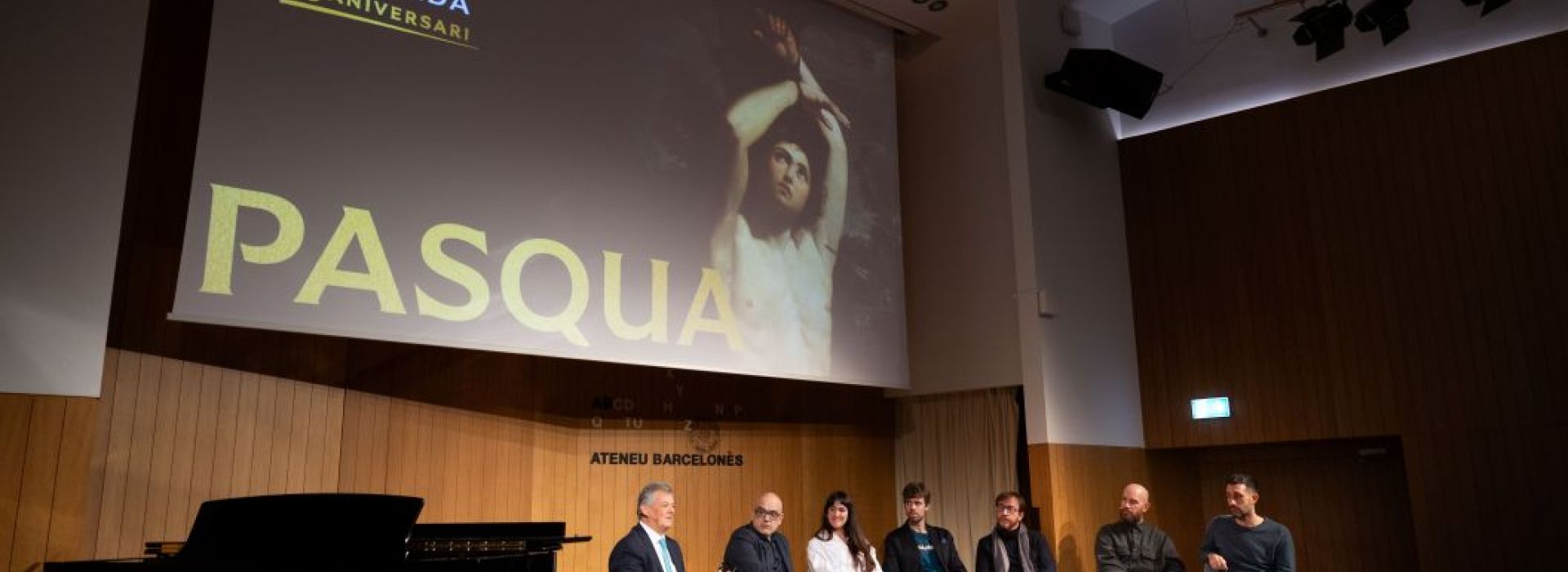
This morning, at the Oriol Bohigas Auditorium of the Ateneu Barcelonès, the artistic programme of the IV edition of the Easter Festival of the Peralada Festival was presented, which will take place from 2 to 5 April 2026 at the Carme church and cloister of the Castle of Peralada.
The event was attended by Oriol Aguilà, artistic director of the festival, and artists associated with this year's programme.
During the press conference, the Cor Francesc Valls, artist in residence for this edition, together with Vespres d'Arnadí, offered two musical performances: at the beginning, with Die Beredsamkeit by J. Haydn, and at the close, with Offertorium für das Fest Johannes des Täufer by Mozart and An die Sonne by Schubert.
The President of the Castell de Peralada Foundation and the Peralada Festival, Isabel Suqué Mateu, through an institutional statement, has highlighted that "this year the Peralada Festival celebrates forty years of commitment to music, culture and artistic creation at the highest level, establishing itself as a project deeply rooted in the territory and at the same time open to the world."In this context, she has emphasised that the Easter Festival "represents a natural extension of this legacy, deepening the spiritual dimension of music and reinforcing our commitment to European musical heritage and to creation".
Suqué Mateu has also highlighted the growth of the audiovisual collection of oratorios recorded at Peralada, which this year will continue with Cristo condannato by Antonio Caldara, performed by Vespres d'Arnadí.
A consolidated Easter in the heart of the Empordà
The artistic director of the Peralada Festival, Oriol Aguilà, has pointed out that "having completed the first three editions, the Easter Festival has established itself as a meeting place during Holy Week for creators, musicians and music lovers seeking an intense musical experience and a time for introspection." According to Aguilà, Peralada offers "a privileged setting where music dialogues with the landscape, historical heritage and memory, especially at a time of year when the inward gaze still prevails."
This fourth edition is also part of the celebration of the 40th anniversary of the summer festival and highlights a martyrdom of Saint Sebastian from the circle of Guido Reni as the visual icon of the festival, reinforcing the dialogue between music, art and spirituality. "This year's programme proposes a journey that rediscovers the essences of universal musical heritage, whilst reaffirming the commitment to contemporary creation, inviting us to reread from the present the ancient liturgies that have accompanied European spirituality throughout the centuries," Aguilà concluded.
Experiencing Easter at the Peralada Festival
The Peralada Easter Festival structures its programme around the musical tradition of Holy Week and the central role of the voice as a vehicle for spiritual expression. In a particularly significant setting such as the Carmelite convent of Peralada Castle, the festival proposes a musical journey that accompanies the listener from the Tenebrae and the contemplation of suffering to the light and hope characteristic of the Easter season.
The fourth edition of the Festival focuses on the great heritage of European sacred music, with works ranging from the Renaissance to Classicism and early Romanticism. The programme combines Renaissance polyphony, Italian, French and German Baroque, and classical sacred music, with special attention to historical recovery, performance with historically informed criteria and the presence of voices and ensembles of international renown.
The human voice becomes the backbone of this year's artistic proposal, both in the great oratorios and liturgical offices as well as in the choral programmes and performative installations. A programme that seeks to balance rigour and emotion, delving into the original meaning of these works and offering the public an intense listening experience contextualised in a space of strong heritage and symbolic significance.
This musical itinerary begins on Maundy Thursday with the recovery in modern premiere in Spain of Antonio Caldara's oratorio Cristo condannato, and unfolds until Easter Sunday with the luminosity of the masses by Mozart and Schubert.
A musical journey at the Carme Church
Maundy Thursday · 8pm
The Festival inaugurates its fourth edition with the revival of "Cristo condannato" by Antonio Caldara, an oratorio premiered on Maundy Thursday in 1717 at the Hofkapelle in Vienna, presented for the first time in modern times in the State. The work, considered one of the most intense by the Venetian composer, proposes a moral and spiritual meditation on justice, guilt and repentance, moving away from the conventional narrative of the Passion.
With a libretto by Pietro Pariati, the action is set during the trial of Jesus before Pontius Pilate, but incorporates allegorical figures such as Il Sacro Testo and L'Anima Compunta, which give voice to the human conscience. Musically, Caldara displays writing of high dramatic charge, with expressive recitatives, arias of great lyricism and a prominent role for the choir. In the words of conductor Dani Espasa, "this oratorio has never been performed in its entirety in modern times, and I have prepared a new edition of the score. It is very moving to bring to light this music of such quality, by a composer who marked the musical life of Barcelona with his presence at the Court of Archduke Charles of Austria in the city and who so greatly influenced the musical history of the Peninsula by introducing Italian opera."
The performance is by Vespres d'Arnadí, with Dani Espasa on harpsichord and musical direction, and a vocal cast formed by Ana Quintans, Maite Beaumont, Nicolas Brooymans, Montserrat Seró and Josep Ramon Olivé. The Cor Francesc Valls takes part, conducted by Pere Lluís Biosca, making its debut at the festival as artist in residence.
Leçons de Ténèbres for Good Friday · 9 p.m
The Good Friday concert will be led by William Christie and Les Arts Florissants, who will perform François Couperin's Leçons de Ténèbres, one of the most intimate and expressive works of the French Baroque. Composed in 1714 for the nuns of the Longchamp convent, these pieces, intended for the nocturnal offices of the Paschal Triduum, constitute a milestone in the French sacred repertoire.
Based on the Lamentations of Jeremiah, Couperin unfolds vocal writing of poignant intensity, with long vocalisations and ornaments of great expressive freedom, which combine introspection, dramatic tension and a subtle theatricality characteristic of liturgical ritual. The programme is completed with works by Marc-Antoine Charpentier and Marin Marais, contemporaries of Couperin, which provide contrasts and broaden the sonic landscape of the French Baroque. In the words of William Christie, "Peralada offers an absolutely magnificent setting for this music. It is a place of great beauty with an audience as enthusiastic as it is expert" and he adds "Couperin's Leçons de Ténèbres are, quite simply, one of the most celebrated pieces of music in the Baroque repertoire intended for the liturgy of Holy Week. They correspond to the golden age of this deeply moving and theatrical ritual. For me it represents one of the most captivating musical examples of this tradition."
The concert offers a sonic experience that recreates the atmosphere of contemplation and tension of the Tenebrae Services, where darkness and silence form an essential part of the ritual. At the end of the performance, the Festival will present William Christie with the Medal of Honour, in recognition of his career and his decisive contribution to the recovery and dissemination of Baroque music.
A Holy Saturday with a double programme · 6pm and 10pm
On Holy Saturday, the Peralada Easter Festival offers a double programme that addresses death and transcendence from two great European traditions: Germanic sacred Baroque music and the Hispanic Renaissance repertoire, with two complementary aesthetic and spiritual interpretations.
In the afternoon, Lionel Meunier and Vox Luminis present Ein deutsches Barockrequiem, a journey through German sacred music of the 17th century and early 18th century based on works by Johann Scharmann, Thomas Selle, Johann Hermann Schein, Christian Geist, Andreas Hammerschmidt and Johann Förtsch. Inspired by Heinrich Schütz's Musikalische Exequien and in dialogue with Johannes Brahms's later Ein deutsches Requiem, the programme combines polyphony and homophony, solemnity and contemplation, to construct a discourse in which death is progressively transformed into consolation and hope. As Lionel Meunier explains, "Ein deutsches Barockrequiem is a kind of homage to Brahms, because the source of inspiration for this programme is his well-known Ein deutsches Requiem. However, we also wanted to approach and give a nod to Heinrich Schütz's Musikalische Exequien, considered to be the first German requiem, even though the term Requiem does not exist in the Protestant religion."
In the evening, the Carme Church will host the Officium Defunctorum by Tomás Luis de Victoria, one of the key works of the Spanish musical Renaissance. Composed in 1605 for the funeral rites of Empress Maria of Austria, this monumental work integrates mass, matins lessons, responsories and motets, unfolding a polyphony of profound spiritual intensity. Alternating homophonic sobriety and refined imitative writing, and integrating plainchant as a structural element, Victoria constructs a sonic journey that expresses the soul's passage before death with an austere and restrained beauty.
O Vos Omnes, under the direction of Xavier Pastrana, presents this work with a balance between historical rigour and expressive force. For the director, "the last work of Tomás Luis de Victoria transcends its initial function and offers a grandiose epilogue, a luxurious final curtain, a 'swan song' – as he himself precisely states in the dedication – for one of the most exuberant periods in the history of music." The circular arrangement of the space, with the vocal ensemble surrounded by the audience and immersed in semi-darkness, reinforces the ritual and contemplative dimension of a music that has traversed centuries without losing relevance or intensity.
A matinée for Easter Sunday
The Easter edition will close its musical programme with a matinée dedicated to the sacred music of Wolfgang Amadeus Mozart and Franz Schubert, two composers separated by generations but united by the same quest for beauty, emotion and spirituality. The concert will be performed by the Franz Schubert Filharmonia, under the direction of Guillermo García Calvo, with the participation of Yewon Han (soprano), Marcela Rahal (mezzo-soprano), Filipe Manu (tenor) and Manuel Fuentes (bass)—all four Peralada Festival Prize winners of the Tenor Viñas Competition in different editions—and the Francesc Valls Choir.
The programme brings together two sacred works by Mozart, the Missa brevis in G major, KV 49, and the motet Ave verum corpus, with Schubert's Mass in G major, D 167. Written when Mozart was only twelve years old, the Missa brevis assimilates the Salzburg stile antico and demonstrates a surprising mastery of counterpoint, in the service of music that is clear, concise and functional for the liturgy. In contrast, the Ave verum corpus, composed in the last months of the composer's life, concentrates in a few bars an intimate and universal spirituality, with an apparently simple writing and a profound emotional charge.
Schubert's Mass in G major, composed at the age of eighteen, is based on the same model of the short mass but incorporates a more expansive lyricism and an expressiveness that anticipates his Romantic voice. The balance between soloists, choir and string orchestra generates a discourse of great warmth, in which formal sobriety coexists with a very marked human and emotional dimension. As Guillermo García Calvo points out, "there are clear connections between Mozart's youthful mass and Schubert's Mass in G major, D. 167. Both are Missae Breves, short, functional works composed by geniuses in their formative stage. Both draw on the tradition of the stile antico and prioritise a clear and direct musical setting of the liturgical text, with a respectful use of counterpoint. However, the link with Mozart's Ave verum is more one of contrast than connection; whilst Mozart's piece achieves a unique mystical depth, Schubert's lyricism in his mass is more earthly."
Contemporary creation will inhabit the Carme Church
On 3 and 4 April, the Peralada Easter Festival presents at the Carme Church the performative installation La luz del lobo no pesa, a creation by Aurora Bauzà and Pere Jou, in collaboration with light artist Jou Serra. The proposal transforms this heritage space into an immersive environment of light, sound and bodily presence, and constitutes the festival's commitment to contemporary creation in this edition.
Conceived as a sensory device, the installation proposes an expanded listening experience in which the perception of time and space dissolves. The work is articulated through a large suspended light structure that dialogues with a sound atmosphere inspired by textless fragments from Alonso Lobo's De lamentatione Ieremiæ Prophetæ, transformed into vocal textures, breaths and acoustic traces that activate the poetic and spiritual dimension of the cloister.
On Friday 3 April, the installation incorporates a live intervention by the Bruckner Choir, under the direction of Júlia Sesé, integrating the choral voice as a living element within the spatial and lighting device. The sessions will take place on the 3rd at 8 p.m. and 10.30 p.m., and on the 4th at 8 p.m. and 11 p.m.
The title of the piece plays with the double meaning of lobo — referring both to the Renaissance composer and to the Spanish word for "wolf" — and opens a poetic reflection on otherness, recognition and coexistence with what we perceive as different. La luz del lobo no pesa constitutes the first phase of a creative process that will culminate with LOBO, a theatrical piece that will premiere this summer at the Festival Grec de Barcelona.
Confluences: context and parallel experiences
The IV edition of the Peralada Easter Festival is not limited only to concerts. As is now traditional, the festival offers a programme of confluences that allows the public to delve deeper into the historical, artistic and spiritual contexts that shape the music performed. These gatherings, organised with the collaboration of cultural entities such as Amics del Liceu, the Reial Cercle Artístic, or the Museu Castell Perelada, include conferences, conversations, and activities that transform the sound experience into a more complete cultural journey, with special attention to Holy Week and European artistic heritage.
4 March · 7.30 pm | Venue to be confirmed
Between pain and hope. The sound of Holy Week in the 17th and 18th centuries
The festival's first confluence offers an immersion into the spiritual heartbeat of the 17th and 18th centuries, when sacred music reflected the death of Christ and human finitude, whilst also offering consolation and transcendence. Joan Vives will guide the audience through the mystical polyphony of the Spanish Golden Age, the evocative delicacy of French Baroque, the robustness of the German tradition and the belcanto luminosity of Italy. Xavier Pastrana will provide the perspective of a composer and conductor who translates these historical legacies into contemporary interpretations, highlighting how each European style conveyed the message of peace and serenity in the face of death.
6 March · 18:00 | Reial Cercle Artístic
A conversation about Il Cristo Condannato: between Venice, Vienna and Peralada
This dialogue accompanies the opening of the festival with the revival of the Baroque oratorio Il Cristo Condannato by Antonio Caldara. Dani Espasa will explain the details of the reconstruction and interpretation of the work, whilst Jaume Radigales, university professor and music critic, will contextualise the piece within European musical history and its current relevance. The event, organised with the collaboration of the Friends of the Liceu and the Reial Cercle Artístic, offers attendees the opportunity to delve into the artistic process and the historical dimension of an oratorio that is arriving in Spain for the first time in the modern era.
2 April · 6 pm | Castle Library (Peralada Castle Museum)
A Martyrdom of Saint Sebastian: from the circle of Guido Reni to the collections of Peralada
This session delves into the iconography of Saint Sebastian and the classicist gaze that Guido Reni transformed into an image of idealised beauty. Ignacio G. Panciello, historian and painting restorer, will analyse the works preserved in the Peralada collections, whilst Susana García, curator of the Castle of Peralada, will contextualise the piece within the heritage and artistic ensemble of the castle. The conference, done in collaboration with the Friends of the Liceu and the Castell Peralada Museum, offers an exclusive look at the historical and artistic value of the festival's heritage.
The Perelada Festival presents the release of the album Tenebrae Responsoria by Joan Magrané
During the event, the album Tenebrae Responsoria by Joan Magrané was also presented, released under the Festival Peralada label. This is the premiere of the composer's Tenebrae Responsories, recorded by Catalunya Ràdio on 29 April 2024, during the second edition of Easter, coinciding with Good Friday. Although the album will not be available for sale, this commemorative edition for the Festival's 40th anniversary will be available on the main digital platforms, allowing listeners to enjoy this premiere of a new creation.
Season tickets and ticket sales:
As for ticket sales, from tomorrow, Friday 30 January, at 10.00 a.m., tickets for the Easter season will be exclusively on sale, designed for those spectators who wish to enjoy the entire programme or several concerts. General sales for each concert will begin on Monday 2 February, also at 10.00 a.m. Ticket prices range from €7 to €70. Ticket sales at www.festivalperalada.com